How many spoons of energy do you have for today?
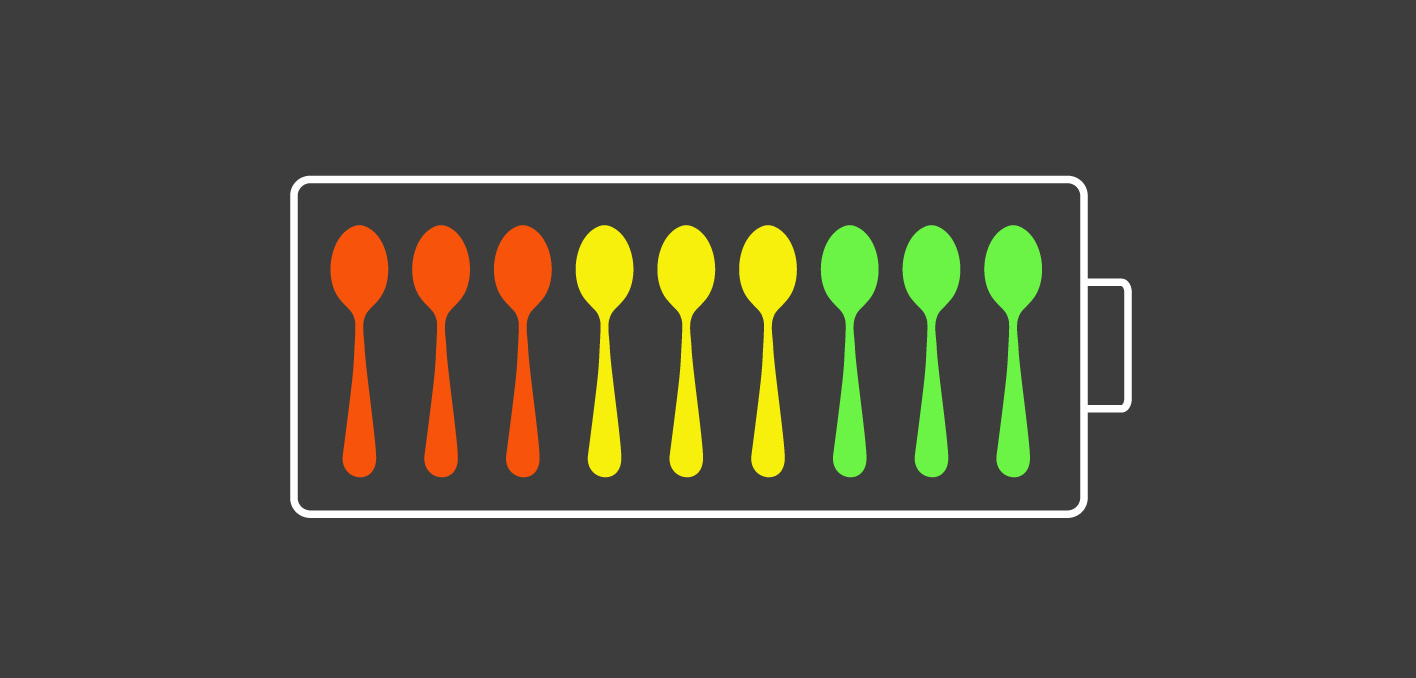
How many spoons of energy
do you have for today?
Most people (or at least that's what they like to think of themselves) humanise the day with unlimited opportunities to do whatever they want without worrying about running out of energy for something. A minority of people, that invisible minority, have it differently.
People with literally invisible illnesses - that is, those chronic illnesses that are not visible at first (or even second) glance - have it even differently. Why? Because in their limitations they are constantly confronted with a reaction full of surprise and incomprehension from those around them, often expressed in a tone full of hidden resentment:
"But you don't look sick after all..."
Christine Miserandino, an award-winning writer, blogger, speaker and advocate for lupus patients, founded ButYouDontLookSick.com in response.
Christina, a lupus sufferer herself, is the author of an analogy that has entered the mainstream under the name Spoon Theory, explaining to healthy people what it is like to live with a chronic illness or disability. Since the theory has made a career, Christina herself has been referred to as the Spoon Lady (Mrs Spoon).
Spoon theory has become a specific identity for the invisible and a cultural way of communicating their abilities.
People call themselves 'Spoonies', which means:
"Individuals with very limited units of energy,
which must be carefully rationed".
Why exactly Spoonies? Well, one day Christina Miserandino was trying to explain to a friend of hers what it was like to live with a chronic illness - and as they were just at dinner... she grabbed all the spoons from her own and her neighbours' tables and used them to illustrate how people with chronic illnesses wake up every day with limited energy.
"At this point the spoon theory was born. I quickly grabbed every spoon on the table; hell, I grabbed spoons from other tables. I looked her in the eye and said, 'well there you go, now you have lupus'. She looked at me slightly confused, like anyone who receives a bouquet of spoons. The cold metal spoons clinked in my hands as I grouped them together and pushed them into her hands.
I explained that the difference between being sick and being healthy is having to make choices or consciously think about things when the rest of the world doesn't have to. The healthy have the luxury of living without choices, something they take for granted. For the most part, they don't have to worry about the consequences of their actions. To make this clear, I used spoons to convey this point. I wanted her to have something to hold that I could take away from her afterwards, as most sick people feel the 'loss' of the life they once knew.
I asked her to count the spoons. She asked why, and I explained that being healthy you have an inexhaustible supply of 'spoons'. But when, as a sick person, you have to plan your day, you need to know exactly how many 'spoons' you will start with.
Now I asked her to write down the tasks she does every day, including the simplest ones. When she talked about daily chores or just cool things to do, I explained how much each would cost her per spoonful.
When she immediately set about getting ready for work, which was her first task of the morning, I interrupted her and took the spoon away. I practically jumped down her throat. I said, 'No! You can't just get up like that. You have to open your eyes and realise that you are already late. You didn't sleep well the night before. You've got to crawl out of bed, and then you've got to make yourself something to eat before you can do anything else, because if you don't, you can't take the medicine, and if you don't take the medicine you might as well give up all the spoons for today and tomorrow'. I quickly took another spoonful and she realised she hadn't even got dressed yet. The shower cost her a spoonful again, just for washing her hair and shaving her legs. Reaching high and low so early in the morning might have cost more than one spoonful, but I thought I'd give her a break; I didn't want to scare her right off. Getting dressed was worth another spoonful....
I stopped her and broke down each task to show how every little detail should be thought through. When you're sick, you can't just put clothes on. I explained that I need to see what clothes I can physically put on. If my hands hurt, buttons are out of the question that day. If I happen to have bruises, I need to wear long sleeves, and if I have a fever, I need a jumper to keep me warm and so on. If my hair is falling out, I need to spend more time on it. And you have to add another 5 minutes on top of that for feeling bad that it took you 2 hours.
I think she was starting to understand when, theoretically, she didn't even go to work and she only had six spoons left."
This is how the spoon theory was born in 2003, and is still used today to explain the complex energy expenditure choices that the invisible make every day. This simple analogy explains that people with chronic illness, chronic pain or disability have a limited amount of energy (represented by spoons) that they can spend on completing tasks on any given day. This means that they have to make many difficult and energy-intensive choices about how to use their resources.
Originally created as an analogy to help explain chronic pain and the day-to-day struggles (that can be behind ordinary tasks) of people with chronic illness and disability, it is now increasingly used in other communities, including mental health and mental illness, as well as in the neurodiversity community.
If you use social media and enjoy searching popular physical and mental health tags, at some point you are bound to come across 'Spoonie' (those who use spoon theory) or the phrase 'running out of spoons' (running out of energy). Spoonies use spoon theory to explain their problems most commonly in terms of energy or pain management, but they may also use it to describe anxiety levels, the ability to cope with external stimuli or crowds, and a whole host of other challenges we may unexpectedly face each day.
Driving on reserve?
During her Spoonie analogy, Miserandino described:
"I rarely see my friend emotional, so I knew I was probably getting through to her. I didn't want her to be upset, but at the same time I was happy that finally someone understood me at least a little bit. She had tears in her eyes and asked quietly, "Christine, how do you do it? Do you really do this every day?"
I explained that there are better and worse days; sometimes I have fewer and sometimes more spoons. But I can never forget it, I always have to think about it. And then I handed her the spoon I kept in reserve, saying simply:
I have learned to live with an extra spoon in my pocket, in reserve.
You always have to be prepared."
And here's the catch... A question for 100 points: can you always be prepared, and how to prep?
Some people identify as Spoonie, but still prefer the fuel tank analogy. Comparative tests of full tank, half tank and quarter tank correlate better with how tired they feel, for example.
Spoon theory doesn't fit into every life for people with disabilities or illnesses, and one of the reasons is that they have no idea how many spoons they will have on any given day. There is no set amount they wake up with. They cannot count on six, twelve or even one spoonful. The theory is that using up energy reserves on Monday will take the strength out of Tuesday. This is certainly true. But it could also be that, despite a completely calm day, one has nothing in the tank for the next day. Until they open their eyes and take their first waking breath, they have no idea what kind of day it's going to be - and even then, they can never be sure what's going to happen in a quarter of an hour.
Perhaps you know what it's like to wake up in the morning with the feeling: "Yes, today is a good day!" and then, within a few hours, or even minutes, the situation turns 180 degrees. Do you think your spoons are ninjas? Whatever it is, there are times when you go from having enough energy to less than zero faster than a gliding fighter jet. Sometimes it's due to a change in the weather, sometimes it's due to stress. Often you have no idea what has happened.
What's more, the amount of energy for an activity changes from day to day. Not everyone can plan how much energy different things will consume. Not everyone can, because they simply don't know. A shower is possible on Monday. But on Wednesday, water will cause pain. On Friday, everything may require 10 times more energy.
"You can have all the energy in the world,
but if you feel that someone has just run over you with a dump truck,
you just won't move."
There are a whole host of variable physical and mental factors that break down the spoon theory in both blades. Yes, it's great when you need to tell the healthy ones about your struggles: family, friends, colleagues, children. But in practice, it gives the wrong idea of having control - which you sometimes just don't have.
Sandy, who has a chronic illness and runs the blog Just Live Forward, wrote that:
There are four things that no one has ever told me about the spoon theory:
1. I don't get the same number of spoons every day.
2. My spoons are different sizes.
3. My spoons today are no longer worth as much as they were yesterday.
4. I can save the spoons for tomorrow - but who knows if I will be able to use them?
Yes, a spoon is not equal to a spoon. It's a big challenge to learn to live with that. On the other hand, it should not be a challenge but a matter of course for societies to start supporting people with physical and mental disabilities, with chronic illnesses, with pain. The MedicAlert Foundation has created a special online test-game according to the Spoon theory, designed to raise awareness and highlight that people with chronic illnesses may have to make everyday choices that the healthy part of humanity takes for granted.
Ms Spoon, Christina Miserandino, misses this ability.
"The hardest thing I ever had to learn was to slow down and not do everything. I struggle with that to this day. I hate feeling excluded, having to choose to stay at home, not to do things I feel like doing. When other people can just do something, I have to put together a strategy worthy of war planning. It's in this lifestyle that makes the difference between being sick and being healthy. It's a wonderful ability: to not think and just act. I miss that freedom. I miss never having to count spoons."